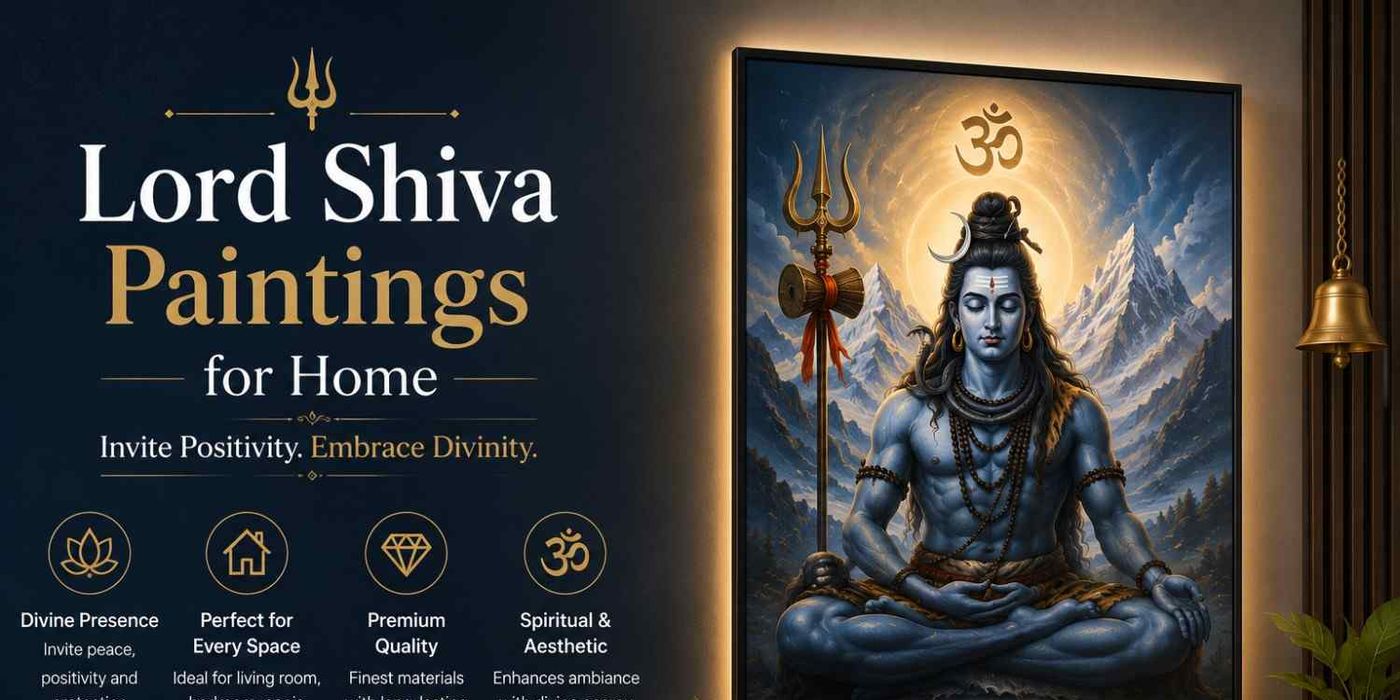
Lord Shiva Paintings for Home: Types, Styles and What to Actually Buy
There's a particular quality to a well-chosen shiva painting it doesn't just sit on a wall. It changes how a room reads the moment someone walks in. Whether you're drawn to a meditative Shiva with half-closed eyes or the charged energy of the Nataraja form, the right piece does something neutral art can't: it makes the space feel chosen, not just decorated.
But most people pick lord shiva paintings without thinking through the medium, the style, or where exactly it will live. The result is usually a beautiful painting that somehow feels out of place too large for the room, too detailed for the wall, or tonally wrong for the interior around it.
This guide covers the full picture formats, styles, room placement, buying criteria, and what wallmantra and similar platforms tend to rank heavily in this space. By the end, you'll know exactly what to look for before clicking buy.
Why Shiva Paintings Work Differently from Regular Decor
Most decorative art is designed to be neutral. Landscapes, abstracts, botanical prints they're picked to not disturb a room's mood. A shiva wall painting operates from a completely different premise.
In Hindu tradition, each form of Shiva carries specific meaning. Shiva in dhyan mudra seated, eyes barely open, crescent moon overhead creates stillness. The Nataraja form, Shiva mid-dance with fire in one hand, brings movement and energy. The Ardhanarishvara, which shows Shiva and Parvati as a single unified figure, speaks to balance between opposing forces.
This is why buying shiva wall decor isn't the same as picking a landscape print. You're not just choosing something attractive you're choosing what you want a room to feel like. That distinction shapes every decision that follows: the form, the format, the size, and where it goes.
The Main Types of Lord Shiva Paintings
Before narrowing down by style, get clear on the medium. The same shiva painting exists in very different formats and each one creates a distinctly different visual effect on a wall.
Shiva Painting on Canvas
Shiva painting on canvas is the most common home decor format, and for practical reasons. Canvas holds colour well, ages without cracking the way paper prints do, and doesn't require glass framing to look finished. A stretched canvas with a deep gallery-wrap frame (1.5-inch depth) sits away from the wall naturally and looks complete without any additional framing.
Canvas paintings come in two forms: hand-painted originals and printed canvas. A hand-painted shiva canvas has visible texture actual brushwork, layering, impasto effects that a print can't replicate. Prints are more consistent in colour across a large format, and significantly more affordable at larger sizes.
For a living room or study, sizes in the 24×36 to 30×40 inch range work well on most standard Indian walls (10-foot ceiling, standard 12-foot wall spans). For a puja corner or small bedroom wall, 16×20 or 18×24 is more appropriate.
One thing to check: lord shiva canvas prints should use UV-resistant pigment inks, not dye-based inks. Dye-based prints fade within two to three years if they catch regular sunlight. Pigment-based inks hold colour for decades.
Shiva Wall Painting (Mural Style)
A shiva wall painting in the truest sense is painted directly on the wall typically by a muralist working in acrylic, lime wash, or natural pigments. This is a more permanent format and a bigger commitment, both financially and aesthetically. But when done well, there's genuinely nothing else like it.
The scale of a shiva mural painting does something framed art can't. At full wall height say 8 to 10 feet a mural stops being something you look at and becomes something you're inside. Shiva at Kailash, with the Ganga flowing from his matted hair and clouds behind him, reads completely differently at that scale versus in a framed 24×36 canvas.
For homeowners who want the visual impact of a mural without the permanence or cost, printed wall mural panels are a strong alternative. Large-format removable wallpaper murals now print at very high resolution and can cover an entire feature wall. A lord shiva mural painting in this format typically ordered as a custom-size print across multiple panels gives you mural-scale presence with the flexibility to remove or replace it.
Colour-wise, deep jewel tones work well for this format: forest greens, midnight blues, and deep burgundies behind the figure create strong contrast without competing with the artwork itself.
Shiva Wall Hanging
A shiva wall hanging is the oldest of the three formats in this list. Fabric-based typically silk, velvet, cotton, or a cotton-polyester blend the wall hanging predates canvas prints by centuries. Traditional pichwai paintings, miniature art, and South Indian Tanjore-inspired compositions are all more commonly found in this format than on stretched canvas.
The textile surface gives a warmth that canvas and print don't have. Light catches fabric differently especially in silk and in certain lighting conditions, a lord shiva wall hanging in a puja room can look genuinely radiant.
Practical advantages: wall hangings are easy to remove, store, fold, and transport. They're a good option for renters, for people who redecorate often, or for anyone who wants to be able to take the art down for religious occasions and festivals.
Styles of Shiva Paintings: Traditional vs Modern
Once you know the medium, look at the style. This is where personal taste and the interior aesthetic of your home determine the right direction.
Traditional Lord Shiva Paintings
Traditional lord shiva paintings follow iconographic conventions that have been consistent for centuries. Shiva appears with a blue throat (Neelakantha, the one who swallowed poison), a crescent moon in his matted jata, a third eye, the sacred trishul, the Ganga flowing from above, and a tiger skin draped at his waist.
Colour palettes in traditional paintings tend toward warm, rich tones: saffron orange, turmeric yellow, deep red, ivory, and gold. These paintings suit classically furnished homes marble flooring, dark wood furniture, or spaces that lean traditional in their material choices.
Traditional shiv parvati photos wallpapers and printed canvas art in this style tend to be the most searched formats overall. Shiv Parvati paintings showing both figures together at Kailash, in a domestic scene, or in a devotional composition carry a sense of wholeness that solo-figure paintings don't. If you're decorating a couple's home or a family living space, the dual composition is worth considering seriously.
Modern Shiva Paintings
Modern shiva paintings take the same iconography and filter it through a contemporary visual lens. The forms include flat design, geometric abstraction, fluid resin art, monochrome line art, and bold expressionist brushwork. All of these exist as commercially available shiva paintings now, and all of them have a market.
If your home has a minimalist interior white walls, clean architectural lines, Scandinavian or Japanese-influenced furniture a traditional richly-coloured shiva painting will look jarring. A modern shiva painting in black and white line art, a geometric trishul and crescent composition, or a resin-poured abstract in blues and silvers will fit far better.
Some modern interpretations strip away religious symbolism almost entirely and work with Shiva as pure form an abstracted face, a single eye, a crescented silhouette. These work well in spaces where devotional art would feel out of place, but the homeowner still wants a personal connection to the subject.
Shiva Face Painting
The shiva face painting format deserves specific mention because it's one of the most consistently searched formats — and it works because a face composition is inherently direct. Unlike a narrative painting that requires some visual parsing, a lord shiva face painting — focused on the half-open eyes, the third eye, the serene expression — hits immediately.
This format is particularly strong in smaller rooms, above study desks, in meditation corners, and in entryways. Even a 12×16 inch shiva face painting holds its own on a wall in a way that a full-composition painting of the same size doesn't.
Shiv Parvati Paintings — Handling the Most Searched Format
Keywords like shiv parvati photo wallpaper, shiv parvati image wallpaper, and shiva parvati photos wallpapers collectively account for the largest search volume in the devotional wall art space — significantly more than solo Shiva compositions.
The reason is straightforward: Shiv Parvati together represents a complete idea, not just a deity. Shiva is the ascetic, Parvati is the householder. Together they represent the union of those two drives — spiritual practice and worldly life. For families, couples, and anyone decorating a shared home, that resonance is real.
In terms of formats, shiv parvati 3d wallpaper and large canvas prints are the most popular physical product versions of these searches. For a living room feature wall, a large-format Shiv Parvati canvas — 30×40 inches or wider — in a richly coloured traditional style creates a strong focal point. For a puja room, something more intimate (18×24) works better.
Room-by-Room Placement for Shiva Wall Art
Placement matters as much as the painting itself. Here's what tends to work well:
Living Room: This is where most lord shiva wall art ends up, and for good reason. The living room is the most-seen space in any home. If there's a single large feature wall — typically behind the main sofa or opposite the entrance — that's the right spot. The cardinal mistake is undersizing. A 24×36 canvas on a 10-foot wall reads like a postage stamp. Go 30×40 or pair two 18×24 canvases as a diptych.
Puja Room: A dedicated puja space has different requirements. It's typically smaller, with existing visual complexity — brass lamps, flowers, incense holders. Shiva painting for home puja rooms should be sized to complement, not compete. An 18×24 canvas or a medium-sized fabric wall hanging in the traditional style is usually right. Muted golds and deep reds work well against the warm light of diyas.
Bedroom: For bedroom placement, stick to the meditative forms — Shiva in dhyan mudra, the Ardhanarishvara form, or a calm face composition. High-energy forms (Nataraja, the Tandava) create a visual restlessness that doesn't suit a sleeping space. Shiva painting on wall in a bedroom reads best when the palette is quieter — dusty golds, muted ochres, soft blues — rather than the high-contrast colours that work well in a living room.
Entryway or Corridor: Often ignored, this is actually one of the best spaces for a bold shiva wall painting. The entryway sets the tone for the entire home. A Nataraja canvas, a large Shiva face painting, or even a framed mural-print in a narrow corridor makes an immediate impression. Since corridors are typically narrow, vertical-format paintings work significantly better than landscape formats here.
What to Check Before You Buy
A few practical buying criteria most listings don't mention clearly:
Frame depth: Gallery-wrap frames come in 0.75-inch and 1.5-inch depths. The 1.5-inch (sometimes called "museum depth") sits away from the wall more noticeably and has a premium look. The 0.75-inch sits flatter — fine for smaller sizes, but looks thin on anything over 24 inches wide.
Hand-painted vs. printed: Don't assume a higher price means hand-painted. Ask specifically. Some platforms list "handmade" when the base is a digital print that's been touched up with acrylic. A genuinely hand-painted shiva canvas will show visible texture on the surface, especially in the background areas.
Size relative to wall: The most common mistake is buying too small. A painting should span roughly two-thirds of the wall width it's centred on. If your wall is 6 feet wide, the painting or a grouping should span about 4 feet. Anything narrower will look like an afterthought.
Hanging hardware: Canvas prints under 20×24 inches are usually fine with a single central hook. Larger canvases need two-point hanging — either D-ring hardware or a hanging wire to prevent tilting over time.
Shivaji Maharaj Wall Paintings: A Related Category Worth Knowing
While this guide focuses primarily on devotional Shiva art, shivaji maharaj wall painting and shivaji maharaj canvas painting have grown into a distinct and fast-growing segment in their own right particularly among buyers in Maharashtra and in the Indian diaspora abroad.
Chhatrapati shivaji maharaj wall painting compositions are historical rather than devotional they carry a sense of pride and heritage rather than the meditative quality of shiva wall art. In terms of formats, the canvas print and large-format mural wallpaper are the dominant choices. Equestrian compositions Shivaji on horseback, fort silhouettes in the background are by far the most popular visual format in this category.
If you're decorating a home where cultural identity is part of the design intent, canvas painting shivaji maharaj in a large format on a dedicated feature wall can be genuinely powerful.
Vastu Basics for Shiva Paintings
For anyone considering Vastu when placing their shiva wall decor: the north-east direction (Ishan corner) is traditionally the most auspicious for puja spaces and religious art. East-facing walls for puja rooms are also considered ideal.
For living rooms, north or east walls are generally recommended for religious artwork. What matters most practically, though, is that the painting is at eye level — not mounted so high that you're looking up at it and that it's adequately lit. A painting in a dim corner, regardless of its quality, loses most of its visual and emotional impact.
Final Thoughts
A well-placed shiva painting for home does something a decorative landscape or abstract never quite manages it makes the space feel intentional. There's a reason certain walls in certain homes stay with you long after you've visited. Most of the time, it's because someone made a specific, considered choice about what went there.
Whether you go with a large lord shiva wall art canvas for your living room, a fabric wall hanging for a puja corner, or a modern shiva painting that fits a minimalist interior — the logic is the same. Buy something specific to the space, sized correctly for the wall, in a format that suits the room's light and aesthetic.
Get those things right, and the painting does the rest.
Browse our full collection of shiva paintings, canvas art, and wall decor at Canvas Groove hand-picked for quality, shipped across India.
Written by
Lovish Taneja is a Director at Canvas Groove. He joined his father Vijay Taneja's printing business in 2020 — a business that has been printing for brands like Fortune, Adani, Emami and Hindustan Unilever since 2000. Lovish learned the printing process on the shop floor in Mayapuri, New Delhi, alongside digital marketing, and now writes Canvas Groove's guides on canvas prints, wallpaper, fridge and door wraps and Vastu décor.
Read more about Canvas Groove or contact the team.
FAQS
Still have questions?
Contact Support